- 26.06.2026
- Verbindungstechnik
How Light Carries Information
Author: David Pike @Samtec
The Science of Optical Interconnects - Part 2
In the first article of this series, we explored why optical interconnects are attracting renewed attention throughout the electronics industry. Bandwidth requirements continue to grow, and system architects are searching for solutions to challenges involving power consumption, density, and scalability.
How does optical fiber actually work?
For many engineers, fiber optics can seem mysterious compared to the intuitive nature of conventional electrical systems. Conductors carry current, contacts transfer signals, and voltage levels represent information. At first glance, optical communication is fundamentally different because the information is carried by light rather than electricity. But under the surface, the concept is surprisingly familiar.
Whether information is transmitted using electrical signals, radio waves, or pulses of light, the objective remains the same. Data must be transferred from one location to another as reliably and efficiently as possible. The transmission medium may change, but the fundamental communication challenge remains remarkably similar.
Optical communication begins by converting electrical information into pulses of light. A transmitter, typically based on a laser or LED, generates light that can be modulated at extremely high speeds. These changes represent digital information in much the same way that changing voltage levels represent data within an electrical system. At the receiving end, a photodetector converts those light pulses back into electrical signals that can be processed by the system. The challenge lies in transporting those light signals over distance while preserving their integrity.
Keeping Light Under Control
A common misconception is that optical fiber behaves like a transparent pipe, with light simply traveling straight through the middle. The optical structure of a fiber consists of two primary layers. At the center is the core, surrounded by a second layer known as the cladding. Both are made from glass, but they possess slightly different optical properties.
The key parameter is refractive index, which describes how light behaves as it passes through a material. By carefully controlling the refractive indices of the core and cladding, engineers can cause light entering the fiber to remain trapped within the core rather than escaping into the surrounding material. This effect is known as total internal reflection.
Although the light may reflect within the fiber, it remains guided by the core and can travel considerable distances with very little loss. This is one of the reasons optical communication has become the backbone of global telecommunications. Signals can travel many kilometers before requiring amplification, distances that would be difficult to achieve using conventional electrical interconnects.
Total internal reflection can be difficult to visualize from text alone. This short video demonstrates how that effect keeps light confined within the fiber core.
This is also one of the reasons fiber can feel counterintuitive. In copper systems, engineers are used to thinking about conductors, resistance, current flow, and contact surfaces. In optical systems, the important concepts are different. The signal is still carrying information, but it is doing so according to the behavior of light rather than the behavior of electricity.
Not All Fibers Are the Same
Once engineers become comfortable with the concept of total internal reflection, they need to understand why there are different types of fiber. The answer lies in the paths that light can take through the fiber.
In multimode fiber, the core is relatively large. This allows light to travel along multiple paths, or modes, simultaneously. Multimode systems are generally easier to align and can use lower-cost optical components, making them attractive for shorter-distance applications such as data centers and enterprise networks.
At first glance, a larger core might seem like the better solution. After all, it provides more room for the light to travel. The challenge is that not all light follows exactly the same route through the fiber.
Imagine a group of travelers attempting to cross a mountain. In one scenario, there are multiple routes available. Some are direct, while others are longer and more winding. Although everyone leaves at the same time, they do not all arrive together. Over time, the group becomes spread out because different travelers have taken different paths.
Single-mode and Multimode
Something similar happens inside multimode fiber. Light entering the fiber can travel along multiple routes, each with a slightly different path length. Over distance, parts of the optical signal arrive at slightly different times, gradually blurring the information being transmitted. This effect is known as modal dispersion.
Single-mode fiber approaches the problem differently. Its much smaller core restricts light to a single path through the fiber. Returning to our mountain analogy, everyone now travels through the same tunnel. The journey may not necessarily be faster, but the group stays together and arrives in a far more orderly manner.
This dramatically reduces dispersion and allows information to travel much greater distances while maintaining signal integrity. It is also important because it illustrates a broader theme that appears throughout interconnect design. There is rarely a single best solution. Different technologies exist because they solve different engineering problems.
Multimode fiber remains highly effective for many shorter-reach applications, while single-mode fiber dominates long-distance telecommunications and increasingly supports the highest-performance optical interconnects. The choice is determined not by which technology is superior, but by which one best matches the requirements of the application.
Fiber Is Not Perfect
Just like electrical transmission, optical signals experience attenuation which reduces signal strength over distance. The difference is how slowly attenuation accumulates within the optical channel. Connectors must also maintain precise alignment when mated, often measured in microns. Dirt and contamination can significantly affect performance.
This is why some engineers remain cautious around fiber. The advantages are clear, but the practical requirements can feel unfamiliar. Copper connectors are usually judged by the reliability of an electrical contact, but fiber connectors must also protect and align a tiny optical pathway.
That need for precision is one of the reasons fiber has traditionally been treated as a specialist technology. Termination, polishing, inspection, cleaning, and test procedures all matter, and a poorly executed optical interface can quickly degrade performance. But this does not mean fiber is fragile in the way that many engineers imagine, just that optical systems need to be designed, packaged, and handled appropriately.
The same is true of any high-performance interconnect technology. Precision RF connectors, high-speed differential pairs, and advanced board-to-board systems all impose their own rules. Fiber is different, but it is not mysterious.
Copper and Fiber Working Together
One of the recurring messages from this series is that copper and optics are not competitors so much as they are complementary technologies.
Short-reach electrical channels remain highly effective for communication within packages, boards, and subsystems. Optical links become increasingly attractive as reach, bandwidth, and density requirements grow.
This trend can be seen in many of the architectures currently being developed for AI and high-performance computing applications. Technologies such as co-packaged optics bring optical engines closer to the processor while retaining electrical interfaces where they remain practical. The engineering challenge is deciding where electrical signaling makes sense, where optical signaling offers advantages, and how to create architectures that can support both.
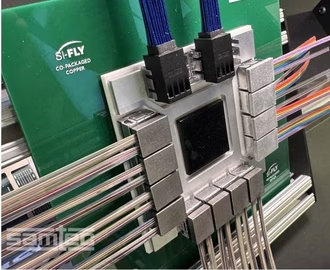
Samtec SiFly HD CPX Optical, Copper-Encapsulated Connectors
The Si-Fly® Samtec’s Si-Fly® HD platform reflects this approach. The same co-packaged connector architecture can support either copper-based short-reach links or optical connectivity at 224 Gbps, allowing system architects to choose the most appropriate transmission medium without fundamentally changing the overall architecture.
That flexibility is important because the future is unlikely to belong entirely to copper or entirely to optics. Increasingly, it will belong to systems that use both technologies where they make the most engineering sense.
In the final article of this series, we will explore what happens when optics move closer to the silicon itself, from co-packaged optics and silicon photonics to the emerging architectures shaping the future of AI and high-performance computing.
More Information
Products
High-Speed I/O Systems
Learn More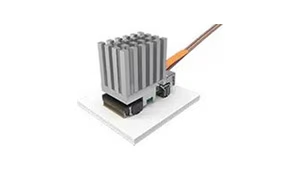
FIREFLY™ Optical Systems
Learn More
Optical Systems
Learn More