- 22.07.2026
- Verbindungstechnik
When light approaches the silicon
Author: David Pike @Samtec
The Science of Optical Connections - Part 3
When discussing the future of optical communications, it’s easy to imagine a world in which copper gradually disappears and is replaced by increasingly sophisticated photonic technologies. Based on everything we’ve explored in this series, that may even seem like the inevitable conclusion. But history teaches us otherwise.
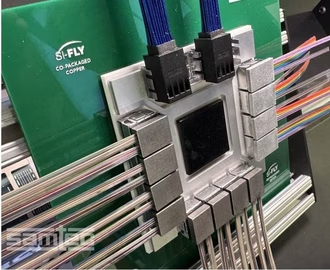
Samtec SiFly HD CPX Optical, Copper-Encapsulated Connector
If the electronics industry has taught us one thing, it is that successful technologies rarely replace one another overnight. Vacuum tubes did not disappear with the invention of the transistor. Parallel interfaces continued to exist long after serial communication had become the standard. Even today, decades after I first heard predictions about the end of copper technology, electrical connections remain central to nearly every electronic system.
The future of connectivity will likely not rely exclusively on copper or fiber optics. Rather, systems that combine both technologies in increasingly intelligent ways will make use of these technologies.
The Distance Problem
For many years, high-speed electrical communication followed a familiar pattern. Signals traveled from the processor across a printed circuit board, through one or more connectors, into a cable, and finally reached another circuit board, where the process began anew. This architecture has served the industry exceptionally well.
However, as we discussed in the first article of this series, the demands of artificial intelligence and high-performance computing are changing the rules of the game. Every millimeter of electrical conductor cross-section results in losses. Every connector, every trace on the circuit board, and every enclosure contributes to losses in the communication channel. As data rates continue to rise, transmitting information across a circuit board can become almost as demanding as processing it. This raises the obvious question: Why not convert the signal into light much earlier?
Bringing Optics Closer
Traditionally, optical communication was located at the edge of the system. Electrical signals traveled through the entire network before finally reaching an optical transceiver, where they were converted into light for transmission over longer distances. This approach makes sense as long as the electrical transmission paths are relatively tolerant, but the requirements for modern systems are entirely different.
Instead of transmitting sensitive electrical signals across the entire circuit board, engineers are exploring ways to move the optical conversion significantly closer to the processor itself. This concept, known as co-packaged optics, shortens the paths of the fastest electrical channels and enables optical connections over greater distances.
This is a subtle architectural change, but one that has a significant impact on power consumption, density, thermal management, and the system's overall performance.
Silicon Is Learning New Tricks
Another technology that is attracting a great deal of attention is silicon photonics. The name may sound intimidating, but the underlying concept is surprisingly simple.
For decades, electronics and optics were developed largely as separate technologies. Electronic devices processed information, while optical components transmitted it. Silicon photonics aims to integrate these disciplines much more closely by incorporating optical functions using many of the same manufacturing techniques that have revolutionized the semiconductor industry.
The goal is not to replace conventional electronics with optics. Processors continue to process information electrically. However, silicon photonics makes it possible to generate, manipulate, and detect light much closer to the silicon than was previously feasible. Similar to integrated optics, it represents another step toward reducing the transmission paths for ultrafast electrical signals.
The connector doesn't disappear
When reading about these new technologies, it would be easy to assume that optics somehow eliminate the need for connectors, but often the opposite is true.
As the speed and density of systems increase, interconnections are becoming increasingly important. Regardless of whether copper or fiber optics is used as the transmission medium, engineers need reliable methods for power delivery, signal transmission, heat dissipation, and the construction of complex systems.
In many cases, the hybrid architecture actually increases the importance of the connector. Electrical and optical technologies must coexist within the same housing, on the same circuit board, or within the same subsystem, which places even higher demands on precision, mechanical design, and manufacturing tolerances. Rather than disappearing, the connector continues to evolve alongside the rest of the system.
Design for Both Worlds
Perhaps the most interesting development is that modern connectivity design is less and less about choosing technologies and more and more about combining them.
Copper remains the best choice for shorter distances, especially where power supply, cost, durability, and ease of manufacturing are important. Optical communication offers compelling advantages as requirements for bandwidth, range, and density increase.
The challenge is not to favor one technology over another, but to understand where each one offers the greatest benefit.
This approach is reflected in platforms such as Samtec’s Si-Fly® HD, which supports both copper-based short-range connections and optical connections within the same integrated architecture. Rather than locking developers into a single solution, it offers the flexibility to optimize the transmission medium according to application requirements.
More Information
Products
High-Speed I/O Systems
Learn More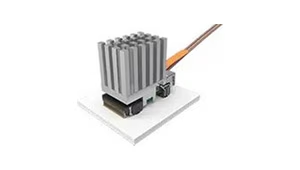
FIREFLY™ Optical Systems
Learn More
Optical Systems
Learn More