- 22.07.2025
- Sensorik
Sensor offers breakthrough in ammonia detection

What is ammonia and where is it used?
Ammonia is a compound of nitrogen and hydrogen with the formula NH3. It is a colourless gas with a pungent odour and a pH value of around 11. Ammonia can dissolve in water to form ammonium hydroxide, a weak base that can neutralize acids. Ammonia in the gas phase is used in a variety of industries and applications, for example:
Cooling
Ammonia gas is used as a refrigerant in industrial and commercial cooling systems. Ammonia gas has a high heat capacity and a low boiling point, making it efficient and environmentally friendly for cooling purposes. However, ammonia gas can also be dangerous if it leaks or mixes with other substances, so appropriate safety measures and maintenance work are required.
Agriculture
Ammonia is a major component of animal waste and fertilizers and plays an important role in the nitrogen cycle of plants. Ammonia gas is used as a raw material for the production of nitrogen fertilizers such as urea, ammonium nitrate and ammonium sulphate, which are essential for increasing plant growth and crop yields.
Chemical
Ammonia is an important raw material for the production of various chemicals such as nitric acid, ammonium nitrate, urea and synthetic fibers. It is also used as a catalyst and solvent in many chemical processes. Ammonia can react with other substances to form explosive or hazardous compounds such as ammonium perchlorate, ammonium hydroxide and nitrous oxide. Therefore, ammonia sensors are used to monitor and control ammonia levels in chemical plants and waste streams and to prevent the formation of unwanted by-products or the release of harmful emissions.
Cleaning and disinfection
Ammonia gas is used as a cleaning and disinfecting agent in various industries and environments, such as hospitals, laboratories and households. Ammonia gas can dissolve grease, dirt and stains and kill bacteria, fungi and viruses. Ammonia gas can also be mixed with water or other chemicals to make solutions such as window cleaners, floor cleaners and bleach.
Pharmaceutical
Ammonia is used as a starting material, stabilizer and buffer in the synthesis and formulation of various pharmaceutical products such as antibiotics, antihistamines, vitamins and hormones. Ammonia sensors can also help to optimize the production and storage of pharmaceutical products by preventing the loss of active ingredients or the formation of impurities. Ammonia is one of the few basic chemicals used as a starting material for the manufacture of all other chemical products. It is the second most produced chemical by mass after sulphuric acid.
Waste water treatment
Ammonia is a common pollutant in wastewater because it comes from the decomposition of organic matter, the discharge of industrial wastewater and the runoff of agricultural fertilizers. In addition, ammonia can interfere with the biological treatment of wastewater by inhibiting the growth and activity of microorganisms that remove organic and nitrogenous compounds.
Why is ammonia detection important?
Ammonium nitrate and ammonium perchlorate are used in the production of solid rocket fuels.
Ammonia can pose serious health and environmental risks if it leaks, spills or accumulates in high concentrations - exposure to ammonia can cause irritation, burns, respiratory problems and even death in humans and animals.
It is therefore essential to monitor and control ammonia levels in various environments such as farms, livestock facilities, cold stores and chemical plants.

STEL (Short Term Exposure Limit) and TWA (Time Weighted Average) are two types of exposure limits used to regulate the amount of a substance that workers may be exposed to over a period of time.
STEL is the maximum concentration of a substance to which workers can be exposed for a short period of time, usually 15 minutes, without adverse health effects occurring. The NIOSH (National Institute for Occupational Safety and Health) and the ACGIH (American Conference of Governmental Industrial Hygienists) have set the STEL for ammonia at 35 ppm for 15 minutes.
TWA, on the other hand, is the average concentration of a substance to which workers can be exposed during an 8-hour working day without adverse health effects occurring. These exposure limits are designed to ensure the safety and health of workers and are set by various organizations - however, exposure thresholds vary depending on the regulating institution. For example, OSHA defines the TWA value for ammonia vapors as an exposure of 50 ppm over 8 hours, while NIOSH describes it as an exposure of 25 ppm over 10 hours.
What are the challenges of ammonia detection?
Detecting ammonia is not an easy task, as ammonia has some unique properties that make it difficult to measure accurately and reliably.
One of the challenges is that ammonia has a high affinity for water, which means that it easily dissolves in moisture and forms ammonium ions (NH4+). This can affect the performance of some sensors as they may not detect the actual concentration of ammonia in the gas phase.
A second challenge is that ammonia is often present in complex mixtures with other gases such as hydrogen sulphide and nitrogen oxides. This can affect the selectivity and sensitivity of the sensor, as some sensors may not be able to distinguish ammonia from other gases or may have a reduced signal due to cross-reactivity.
The background concentration of ammonia gas can pose a challenge for electrochemical gas sensors as these sensors rely on consumables for detection, which can be affected by prolonged exposure to ammonia. This can ultimately limit the life of the sensor depending on the cumulative ammonia exposure.
In addition, typical ammonia sensors are prone to drift (i.e. a gradual change in sensor output over time). This can happen when the sensor is exposed to low background concentrations of ammonia for extended periods of time, causing the baseline to shift and affecting the accuracy and reliability of the measurement. Drift can also be affected by factors such as temperature, humidity and ageing of the sensor components.

How does the sensor overcome these challenges?
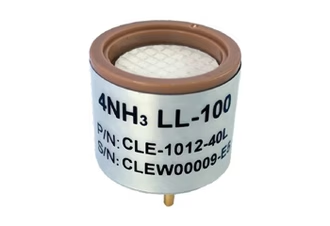
The 4NH3LL-100 sensor is a new product that has been developed to overcome the challenges of ammonia detection and provide customers with a superior solution.
The 4NH3LL-100 sensor offers several advantages over conventional sensors, including
- The sensor can be operated under a wide range of environmental conditions and provides stable and accurate readings. The 4NH3LL-100 does not require external temperature control or protection devices to operate in harsh temperature conditions.
- It can be operated continuously at background concentrations of ammonia without affecting the performance of the sensor.
- It is durable and low-maintenance, which means it has a long service life.
- The 4NH3LL-100 sensor is also designed for easy operation and integration into various systems and platforms - it has a compact and lightweight design so that it can be installed in confined spaces and portable devices.
What applications are there for the sensor?
The 4NH3LL-100 sensor is ideal for a wide range of applications that require ammonia detection, such as:
Agriculture and livestock farming:
The 4NH3LL-100 sensor can monitor ammonia levels in animal houses, slurry tanks and biogas plants, helping to improve animal welfare, reduce odours and optimize biogas yields.
Cooling:
The 4NH3LL-100 sensor can detect ammonia leaks in cooling systems, helping to prevent equipment damage, product loss and safety risks.
Chemistry:
The 4NH3LL-100 sensor can measure ammonia concentrations in chemical processes and help to control the quality, efficiency and safety of products and processes.
The 4NH3LL-100 sensor can also be used for other applications where ammonia plays a role, for example in food processing, waste water treatment and air quality monitoring.
And more:
The 4NH3LL-100 sensor can also be used for other applications where ammonia detection is required, for example in food processing, waste water treatment and air quality monitoring.
Further information
Overview of sensors
Learn more
Products
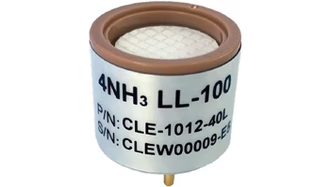
4NH3 Series
Learn more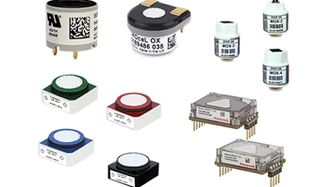
Overview of gas sensors
Learn moreContact person
André Schärer will be happy to provide you with information on our range of sensors.

André Schärer
PM Sensors