

Industry Standards in Electronics
Author: Laura Kachnavage @Samtec
What Are Industry Standards?
Standards are all about compatibility and interoperability. End customers, especially government agencies and their primes, want standardization versus customization to bring down cost of items, improve availability and shorten lead times. Think of them as blueprints to a house, where the contractor can ensure the foundation, wiring and plumbing are well defined and repeatable, but the style, paint colors and furniture are left up to the designer’s discretion.
Companies with vested and sometimes competing interests, along with members of academia, collaborate in work groups and technical committees to develop industry standards. A considerable amount of research and development, sometimes taking years, are needed to scrutinize over the details to ensure the dual target mandates of compatibility and interoperability are met.
Industry Standards and Interconnects
Standards often define plug-in modules, mezzanine cards, daughter cards and backplanes. They typically specify a connector type as well, such as those that Samtec designs and manufactures. These connectors are chosen for their pinout capabilities, materials selection, mechanical features and board terminations to ensure they meet the ruggedness and performance demands of the end use environment. It might also govern how data is transmitted and received between devices (referred to as protocols: we’ll deep-dive protocols in a following blog).
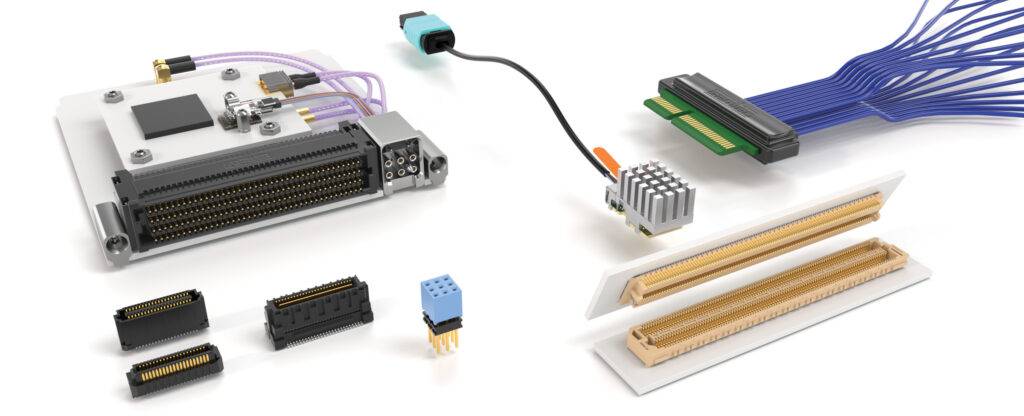
Due to the wide range of interconnect solutions Samtec has to offer, we participate in a variety of standards groups. These groups are typically formed around the end use environment such as mission-critical military and aerospace systems or scalable, cost-effective solutions for industrial automation, telecom and edge computing applications. Examples include VITA, SOSA, PICMG and SGeT to name a few. Samtec being a part of these work groups provides interconnect-specific thought leadership to ensure the best solution to meet all needs; both physical and electrical performance for the use cases are met.
As technology advances and needs begin to change, older standards are often reviewed to either revise or to use as a building block for a new standard. Due to preexisting adoption and acceptance by the communities that use them, new standards often build on an older standard given its purpose is still valid, but can be made smaller and perform faster with better signal integrity than before.
There is an immense amount of effort put into the development of each standard. As a result, products designed-in can have long life cycles of 10-20+ years. Ease of doing business, known as Samtec Sudden Service®, and our high standard for quality results in Samtec product often being selected for these standards.
Samtec Products in Industry Standards
Below are some examples of Samtec products that are used in the electronics industry's common standards.

COM-HPC uses 400-pin or 800-pin connectors based on Samtec’s AcceleRate® HP high-performance array connectors.
WATCH THE VIDEO

PCI-EXPRESS: Samtec offers both connector and cable solutions that meet PCI Express electrical and mechanical specifications, including high-speed edge card sockets and PCI Express®-Over-FireFly® copper and optical cable assemblies.
DOWNLOAD THE BROCHURE

QMC / VITA 93: The VITA 93-standard relies on the high-speed capabilities and the slim, dense design of Samtec’s AcceleRate® HD ultra-dense, slim body arrays. The 80-pin QMC connectors are available in 9, 11, 14 and 16mm stack heights with single-, dual-, or triple-width modules.

VNX+ / VITA 90: VITA 90 VNX+ defines multiple SEARAY™ connectors for both backplane and plug-in modules in 13 and 19mm stack heights, producing a variety of pin counts to complement Half and Full VITA modules. VITA modules also incorporate Samtec hardware, RF and power solutions. An MT ferrule slot on select modules provide optical connectivity where Samtec’s FireFly™ transceiver or HALO® rugged optical solutions may be used.

SFF-SIG SUMIT: SUMIT is a stackable, I/O-centric serial expansion approach supporting PCIe, USB, LPC, SMBus, and ExpressCard signals on a single high-speed connector such as Samtec’s Q2™ (QMS, QFS) products.