UV-resistant digital printing
Opens up a wide range of design possibilities
Hammond's recent investments in additional printers in the United Kingdom, Canada and Basingstoke to expand its facilities. As a result, the modification operation at the head office has been relocated to a separate building, which offers more space and room for further expansion.
A summary of product printing is probably helpful. For many years, single-colour manual screen printing or pad printing were the only processes available for applying single-colour graphics and text to a surface. The process was slow and required a lot of set-up time to achieve acceptable results. The possibilities for creativity and corporate identity were limited, and although multiple colours could be printed, drying time was required between colours, and the target part had to be precisely aligned in a fixture to ensure that the additional colours were printed in the correct place. For most applications, screen printing was sufficient for adding labels to front panels and other flat surfaces to indicate the functions of various switches and controls. Screen and pad printing still have their place for relatively simple applications, but the development of UV-curable digital printing allows industrial designers to create graphics on curved and flat plastic and metal surfaces as if they were in a printed document. Set-up costs are significantly lower, as no screens or pads need to be produced, saving time and enabling the economical production of small quantities. Since digital printers typically have four additional separate inks in addition to the traditional four CMYK colours, additional textures and selective matt and gloss areas can be easily achieved in a single pass. The appearance of the end product is limited only by the imagination of the project engineer.
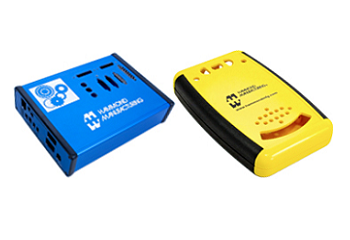
The enclosure determines the appearance of the end product. Hammond therefore offers its own modification options to adapt the standard product to the requirements of an individual project. At the top of the list of options are UV-curing digital printing and traditional screen printing. Digital printing makes it possible to add eye-catching graphics and lettering to the product. The printer has eight outputs: the traditional four CMYK colours and clear lacquer, two shades of white and a primer, which can be used to achieve an impressive variety of finishes. The primer, which is applied selectively to the desired areas of the surface, ensures excellent, sharp results on smooth and textured surfaces. The machine can print right up to the edges of curved surfaces. The clear coat ink can be used to give selected areas or the entire surface a high-gloss, matt or embossed finish, greatly expanding the creative possibilities for logos, backgrounds and lettering. An integrated library of 129 different textured effects provides virtually unlimited design options.
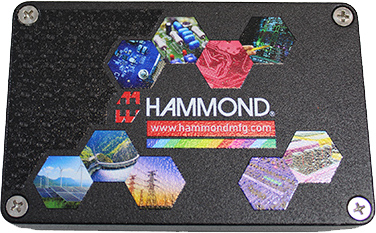
High-quality digital printing ensures that the end product reflects its inherent quality, supports brand identity and offers sharp, wear-resistant solid and gradient colours as well as textural effects on flat and curved panels and other surfaces. A key advantage of commissioning the original manufacturer to do all the work, which saves both time and money, is that there is no need to send semi-finished components to multiple specialist contractors for the various processes. A single order covers exactly the quantity required, eliminating the need for over-ordering for initial samples and approvals in multiple stages.
The main features and advantages of full-colour UV printing are that it can be used to print on a wide variety of flat and curved surfaces with smooth or textured finishes. In terms of size, 19" (483mm) wide panels with a height of up to 9U (400 mm) can usually be printed with razor-sharp images right up to the edge on smooth, textured and curved surfaces. Complex and colourful graphic designs are reproduced faithfully with outstanding clarity. Customer templates are imported in a range of industry-standard file formats to avoid transfer errors. Both spot colours and colour gradients can be printed with glossy, matt and textured finishes across the entire surface or selected highlighted areas. Advanced software control minimises banding and uneven colours on large areas.
Product printing has come a long way since the days of single-colour screen and pad printing. Taking full advantage of the possibilities offered by UV-curing digital printing opens up a wide range of design options, supports strict corporate identity requirements, strengthens brand awareness and ensures a more aesthetically pleasing end product.
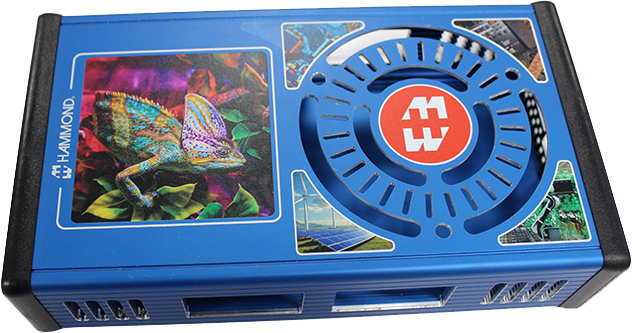
Modification services:
Hammond's in-house modification services bring your project to market on time and within budget.
By definition, all standard enclosures must be configured for a specific application. We have thousands of standard enclosure designs and sizes and can offer modifications for orders of 25 units or more. By working with us, the original manufacturer, you avoid waste and confusion when implementing your requirements.
Hammond offers:
- Precision CNC milling of holes, cut-outs, pockets, threads and countersinks.
- UV digital and screen printing.
- Engraving of logos and text in plastic and metal.
- Pressed-in hardware – nuts, bolts and spacers.
- Custom moulding colours. All ABS, flame-retardant ABS and polycarbonate enclosures can be moulded in any colour subject to a minimum order quantity.
- Custom painted colours – powder coating in smooth or textured finish.
- Custom anodised colours for extruded enclosures subject to a minimum order quantity.
For customised housing modifications, please use our enquiry form.
retour à "News"